





Journée d’étude
Oralité et scripturalité en français médié
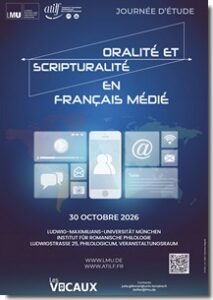
Date : 30 octobre 2026
Lieu : München | Ludwig-Maximilians-Universität | Institut für Romanische Philologie | Ludwigstraße 25, Philologicum, Veranstaltungsraum
Organisation : LMU München (Institut für Romanische Philologie) | ATILF (CNRS – Université de Lorraine)
Contacts : dufter [at] lmu.de | julie.glikman [at] univ-lorraine.fr
Site Web : https://www.romanistik.uni-muenchen.de/je-francais-medie
Télécharger l’affiche
Visualiser le programme
Disponible prochainement
Résumé
Preliminary analyses point to substantial grammatical and textual-structural differences between voice and text messages. This is theoretically significant: according to the model of orality and literacy developed by Peter Koch and Wulf Oesterreicher, both formats – given their comparable communicative conditions – would be located at the pole of communicative immediacy (Nähesprache). The empirical findings therefore invite a reassessment of the relationship between communicative modality, medium and conceptualisation. In particular, they challenge the notion of medium transferability advanced by John Lyons and the presumed independence of medium and conception as formulated in Koch and Oesterreicher’s model. The workshop will address three central questions:
– How do new conventions and discourse traditions emerge in digital writing?
– How are monologic voice messages opened, structured and closed?
– What discourse-pragmatic differences can be observed between text and voice messages?
Bringing together established and early-career researchers working on digital communication, the event will present corpora, empirical analyses and theoretical reflections on multi- and transmodal interaction. A particular aim is to foster dialogue between French and German linguistic traditions.
Beyond its theoretical contribution, the workshop has clear broader impact. It will examine implications for concepts of linguistic correctness, language norms and language pedagogy, areas in which digital communication increasingly challenges established assumptions. Moreover, the event will serve as a platform for preparing a joint proposal within the ANR–DFG Funding Programme for the Humanities and Social Sciences (with Julie Glikman and Andreas Dufter as Principal Investigators), thereby strengthening Franco-German research collaboration.