





Projet européen de formation doctorale
Multilingual Language Awareness in the European Digital Society
Financement : Commission Européenne Horizon Europe Actions Marie Skłodowska-Curie
Durée du projet : 48 mois de 2026 à 2030
Coordination : Université de Lorraine, ATILF (UMR 7118 | CNRS – UL)
Porteuse du projet : Hélène Vinckel-Roisin, co-responsable de l’axe de recherche Lexique de l’ATILF
Contact : helene.vinckel-roisin [at] univ-lorraine.fr
Télécharger l’affiche | le flyer
Web : www.multilawa.eu
Le projet européen de formation doctorale (Doctoral Network- Joint Doctorates, DN-JD) des Actions Marie Skłodowska-Curie Horizon Europe, Multilingual Language Awareness in the European Digital Society (MultiLAwa) figure parmi les lauréats de la session MSCA 2025 !
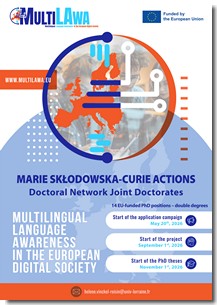
Le projet est sous le leadership de l’Université de Lorraine, avec un ancrage scientifique à l’ATILF. Le financement obtenu permettra de recruter 14 doctorantes et doctorants via un contrat doctoral de 36 mois, dont 4 seront inscrit·e·s en co-tutelle de thèse à l’UL. La phase de recrutement des doctorantes et doctorants démarrera le 20 mai 2026. Les projets de thèse (‘individual research projects’) commenceront dans les 10 universités partenaires le 1er novembre 2026.
À l’image du pluri-/multilinguisme à l’ère du tout digital et de l’IA promus dans le projet, les langues communes de communication en interne et de formation doctorale seront l’anglais et l’allemand. Les 14 projets de thèse couvrent, eux, des langues comme l’anglais, le français, l’allemand, l’italien, le portugais, le danois, le polonais tout autant que certaines langues régionales et langues indigènes !
Visualiser le flyer
Abstract
MultiLAwa advances pluri-/multilingualism as a key driver of social cohesion and inclusion by promoting Language Awareness (LA) – the explicit and implicit knowledge of language(s) and language use – across individual, institutional and societal levels.
Going far beyond existing research and doctoral training initiatives, the project’s overarching objective is to analyse the interconnections between LA, pluri-/multilingualism and digital transformation, and to translate this knowledge into practical solutions by:
– investigating how LA can serve as a competence for navigating Europe’s digital transition, and how digital progress can foster LA and pluri-/multilingualism;
– developing new theoretical, methodological and empirical foundations for LA in the digital age;
– creating innovative digital resources and guidelines to raise LA and thus enhance pluri-/multilingualism.
Bridging the gap between academia and industry, MultiLAwa brings together 10 European universities and 16 associated partners (including 11 non-academic organisations) in an exceptional multi-stakeholder consortium. MultiLAwa will train a new generation of 14 young plurilingual researchers to become experts capable of addressing language-related challenges in a rapidly digitalising society – contributing to sustainable, inclusive and pluri-/multilingual ecosystems across Europe.
Consortium members
Université de Lorraine, ATILF, FR (Coordination)
University of Innsbruck, AT
University of Vienna, AT
University of Zurich, CH
Friedrich-Alexander Universität Erlangen-Nürnberg, DE
University of Mannheim, DE
University of Copenhagen, DK
University of Milan, IT
University of Warsaw, PL,
Nova University Lisbon, PT
16 Associated partners (academic: 5; non-academic: 11):
Swiss National Bank, CH
Univerbal, CH
Charles University, CZ
Lexical Computing, CZ
Berlin-Brandenburg Academy of Sciences and Humanities, DE
Center for Rhetorical Science Communication Research on Artificial Intelligence, DE
Dudenredaktion Cornelsen Verlag GmbH, DE
Ernst Klett Verlag GmbH, DE
Leibniz Institute for German Language, DE
Ordbogen A/S, DK
WeDo – Project, ES
Ministère de la Culture, FR
Observatoire européen du plurilinguisme, FR
United Nations Educational, Scientific and Cultural Organization, FR
Interhome Group, IT
Zenter fir d’Lëtzebuerger Sprooch, LU
Aller plus loin
Lire l’article MultiLAwa : l’Université de Lorraine décroche un Doctoral Network d’excellence européenne sur le multilinguisme à l’ère numérique sur Factuel UL.
Lire l’interview et le portrait d’Hélène Vinckel-Roisin à l’occasion de la journée de l’Europe le 9 mai 2026
Page perso d’Hélène Vinckel-Roisin